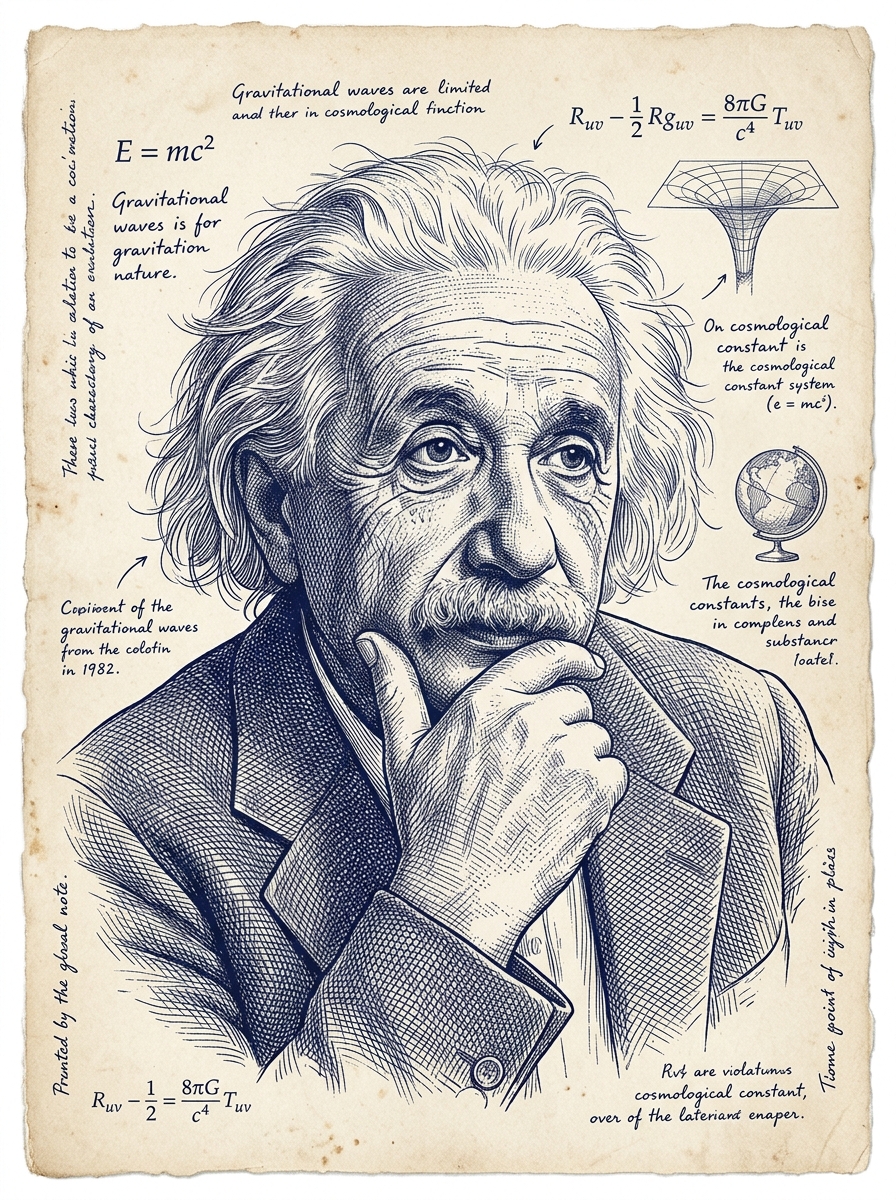
Albert Einstein
“The greatest blunder of my life.”— Albert Einstein, on withdrawing the cosmological constant, ~1931
He was wrong. This paper proves the cosmological constant was always required — and always positive. The withdrawal was the real blunder.
In 1917, Einstein had a problem.
His field equations described a dynamic universe — one that would expand or contract. But almost everyone, including Einstein, assumed the universe was eternal and static. So he added a term: Λ. It balanced the equations and held the universe still.
He called it the cosmological constant. He added it not because the algebra demanded it, but because he wanted a static universe. Ironically, the algebra did demand it — but for the opposite reason. As this paper shows, Λ > 0 is the only choice consistent with Einstein’s own two postulates. The universe couldn’t stay still. The constant he introduced to hold it still was the very constant that required it to move.
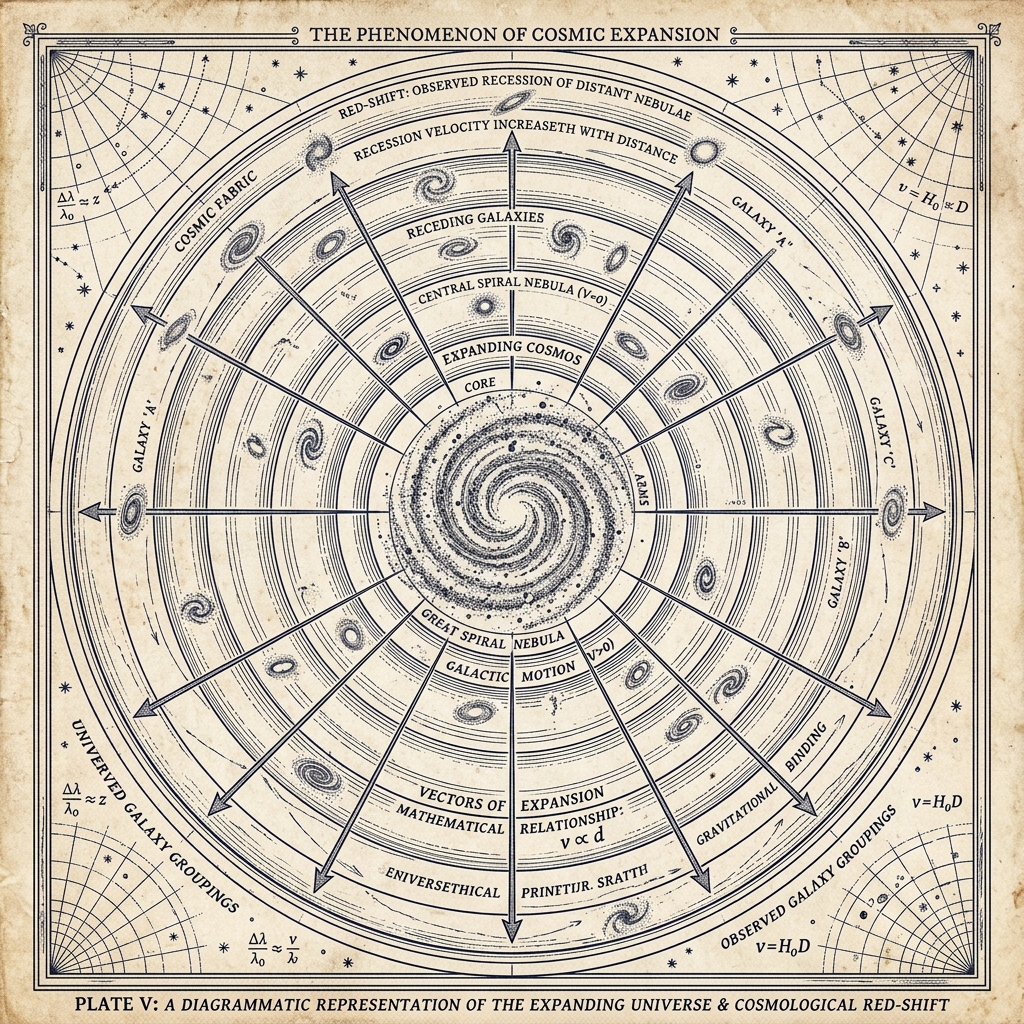
In 1929, Hubble proved the universe was expanding.
Galaxies were moving away from us. The further they were, the faster they receded. Edwin Hubble had measured the expansion rate. The universe was not static. It was growing. Georges Lemaître had already derived this from Einstein’s equations two years earlier — but Einstein had resisted the conclusion.
Einstein conceded. He withdrew Λ — reportedly calling it the greatest blunder of his life. The constant he had introduced to prevent expansion was no longer needed, he thought, because the universe was expanding anyway. So out it went.
“The universe is expanding. Einstein’s equations already contained this — he just didn’t believe it at first.”— Georges Lemaître, 1927 (paraphrase)
In 1998, the blunder came back.
Astronomers measuring distant supernovae found something shocking: the expansion of the universe wasn’t slowing down. It was speeding up. Something was pushing the universe apart. Something with the properties of a positivecosmological constant.
That something was Λ. It had been right all along. The three astronomers who made this discovery — Saul Perlmutter, Brian Schmidt, and Adam Riess — received the Nobel Prize in Physics in 2011.
“We measured the expansion of the universe and found it is accelerating. Something is pushing the universe apart.”
— Perlmutter, Schmidt & Riess, 1998 (paraphrase). Nobel Prize in Physics, 2011.
This paper shows the blunder was the withdrawal.
The sign of Λ — that it must be positive — was already determined by Einstein’s own postulates, written in 1905 and 1907. The algebra of spacetime has no room for Λ ≤ 0. He didn’t make a blunder in 1917. He made a blunder in 1931.
More precisely: the paper by Emad Mostaque shows that the Killing form of the spacetime algebra — evaluated on the translation generators — has sign −6Λ. For this to be consistent with both of Einstein’s founding postulates, Λ must be strictly positive. The cosmological constant was never a free parameter. Its positivity was a logical necessity.
The Observational Confirmation
Saul Perlmutter, Brian Schmidt, and Adam Riess won the 2011 Nobel Prize in Physics for discovering the accelerating expansion of the universe. The current best estimate from the Planck satellite and Dark Energy Survey:
Λ ≈ 1.1 × 10⁻⁵² m⁻²
Tiny — but definitively positive. Einstein was right.
The cosmological constant is not a blunder. It is a law. And this paper shows it was always going to be positive.