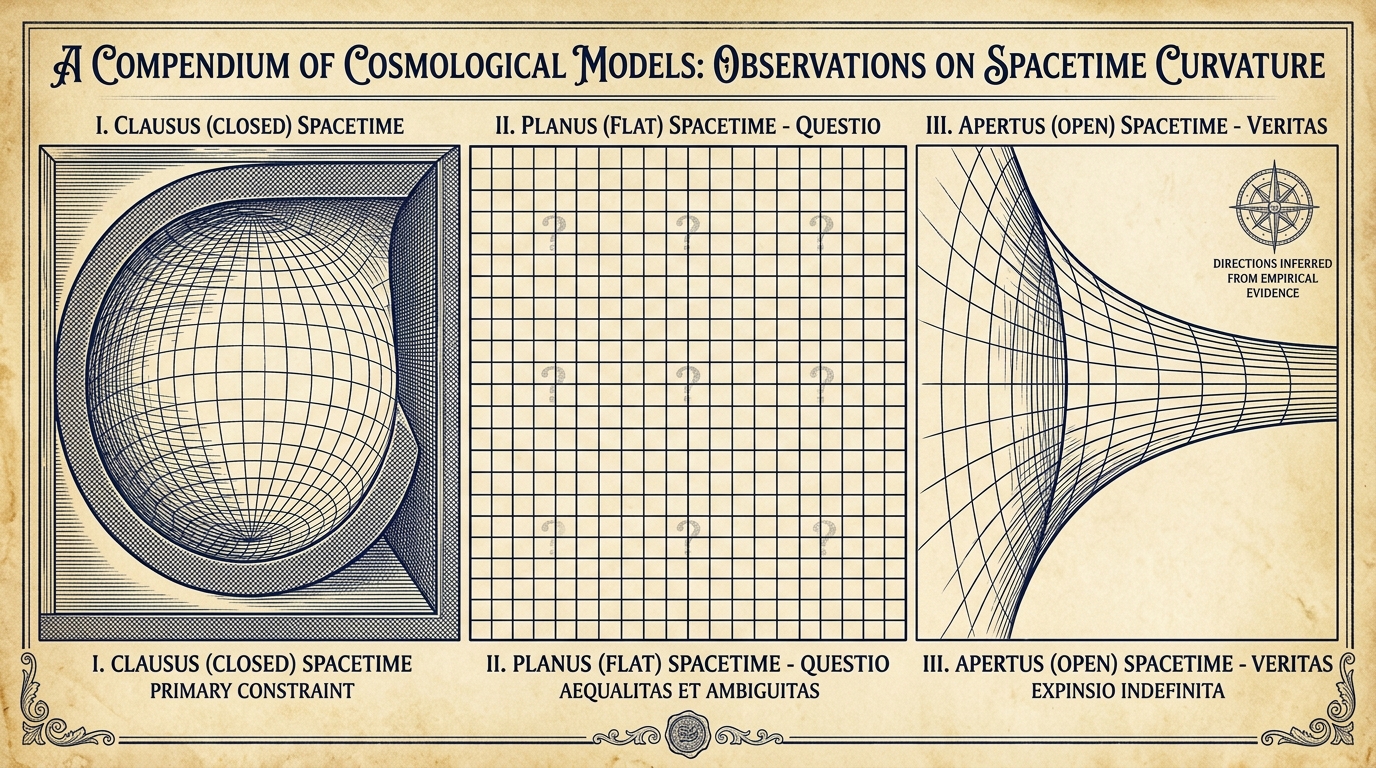
Three possible spacetime geometries. Left: walled, constrained (Λ < 0). Centre: flat, undetermined (Λ = 0). Right: open, self-contained (Λ > 0).
The three candidates
| Property | Λ < 0 | Λ = 0 | Λ > 0 |
|---|---|---|---|
| Killing form on P₀ | Non-zero | Zero | Non-zero |
| Algebra type | Anti-de Sitter (AdS) | Poincaré (flat) | de Sitter (dS) |
| Curvature radius L | 1/√|Λ| | None | 1/√Λ |
| Metric determined? | No | No | Yes |
| Globally hyperbolic? | No | Yes | Yes |
| Boundary conditions needed? | Yes | Yes (external scale required) | No |
| Self-contained under relativity? | No | No | Yes |
| Built-in scale from within? | Yes | No | Yes |
| All requirements satisfied? | No | No | YES |
“We finally infer that boundary conditions in spatial infinity fall away altogether...”
Albert Einstein, Kosmologische Betrachtungen, 1917
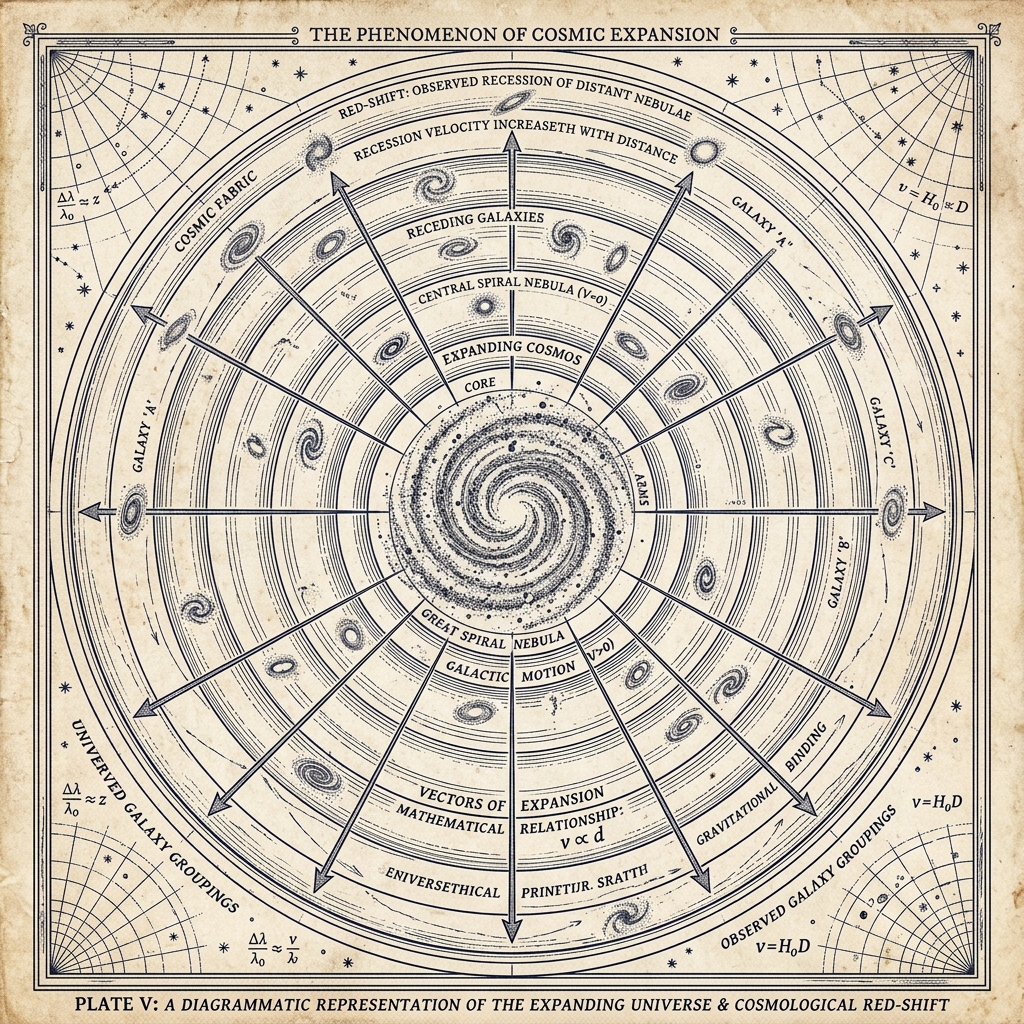
The Universe That Cannot Help But Grow
de Sitter space, the universe with Λ > 0, is not just “allowed” to expand. It is fundamentally, algebraically required to. The curvature radius L = 1/√Λ is determined internally. The expansion rate H = √(Λ/3) follows. These are not facts you add to the theory. They emerge from the theory itself.
Einstein’s 1917 introduction of Λ was not a patch or a fudge. It was the only self-consistent choice.